Table Of Content
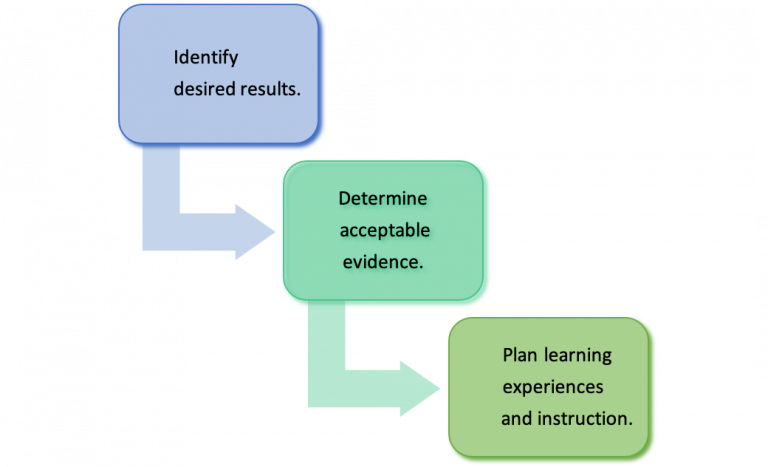
Backward design in education is a lesson planning strategy that starts with the final assessment, then asks teachers to build their lessons toward that goal. This differs from transitional lesson design, in which teachers identify content they need to cover, build relevant lessons, then create the final assessment. Backward lesson design encourages teachers to be more intentional about their lesson plans and ensures that they make the best use of class time. Some teachers may fear that backward design emphasizes “teaching to the test,” which puts unfair pressure on students to learn for the sake of the final assessment. However, it is up to the skilled teacher to emphasize the process of gaining new knowledge, as opposed to acing the final test. While it can be difficult to grasp at first, backward design encourages educators to be intentional with their lesson planning, since it imbues the class time with a specific purpose.
Higher education can leverage lessons from the pandemic to improve the online learning outcomes for working adults - Times Higher Education
Higher education can leverage lessons from the pandemic to improve the online learning outcomes for working adults.
Posted: Tue, 02 Mar 2021 21:04:06 GMT [source]
Part 2: Backwards Design and Designing Assessments
A defining feature of Backward Design is its alignment between learning objectives, assessments and feedback, and learning activities and instructional materials. In this template, think of goals as the course learning outcomes (CLOs), the essential understandings as the core concepts and competencies, and performance tasks as the learning objective. Instructional strategies are the teaching methods by which you present new information to your students. Methods can include teacher-centered approaches like demonstrations or lectures, or student-centered approaches like peer discussion and inquiry-based learning. Your backwards lesson planning should incorporate both instructional strategies and instructional activities.
The Three Steps of Backward Design Are:
Your learning outcomes should be achievable for the students in your class and achievable in the time allotted to your subject. Crafting realistic learning outcomes requires some understanding of students’ prior knowledge and skills in your subject. The purpose of the backward design is to ensure that students are learning the most important material. This ensures that all of the activities and assessments are aligned with the desired learning outcomes.
Determine appropriate assessments
I was first introduced to this concept in my sixth year of teaching, and the genius of it completely blew me away. I used it when planning my next unit and experienced the biggest spike in student success I’d ever seen. On top of that, I was actually excited about teaching the lessons I had planned.
How Can We Align Learning Objectives, Instructional Strategies, and Assessments?
In most public schools, the educational goals of a course or unit will be a given state’s learning standards—i.e., concise, written descriptions of what students are expected to know and be able to do at a specific stage of their education. As a strategy for designing, planning, and sequencing curriculum and instruction, backward design is an attempt to ensure that students acquire the knowledge and skills they need to succeed in school, college, or the workplace. In other words, backward design helps educators create logical teaching progressions that move students toward achieving specific—and important—learning objectives. Backward Design is an instructional design approach that begins by first defining the desired outcomes and objectives and then creating the assessments, instructional activities, and materials to help learners achieve those outcomes.
Coherent learning experiences & teaching that evoke and develop the desired understandings, promote interest and make excellent performance more likely. With this clear target in place, educators are better equipped to teach. Backward design is a systematic and intentional way to ensure that students are learning relevant topics. It focuses on equipping students with the information and skills they need not what needs to be covered. You can also use technology and other tools to improve your lesson plans and make teaching more interesting for students.

This feedback guides you in adjusting instructions and ensures that all students are learning. First, I think about what skills I want my students to have at the end of the year—this can be based on both essential social and emotional skills and the needs of current students. All kids need to learn kindness, cooperation, collaboration, etc., but maybe some require more help with time management or self-advocacy. Make a list of all the skills they need—these are your essential questions or enduring understandings. The first step to producing quality online, blended or face-t0-face courses is quality course design.
Teaching Guides
But if a known final test or assessment is required, then backward design can be a useful way to prepare learners to perform well on the final assessment. I care how I am remembered, not because I want to be cool or be “liked,” but because I believe that creating and modeling healthy relationships is the most important thing we can do as educators. How we treat our students models not just how they should treat others, but how they should treat themselves. If I want my students to be less anxious, be more confident, have a growth mindset, and be kind, it starts with me, and every interaction matters. After all, how do we know students have learned anything after we have taught them if we don't assess them on what we hope they have learned? Since Wiggins helped McTighe write UbD a while ago, I was curious to know how much progress we as educators have made since then.
Match Fishtank: Creating quality, culturally relevant, and openly-licensed curricula - New America
Match Fishtank: Creating quality, culturally relevant, and openly-licensed curricula.
Posted: Mon, 27 Jan 2020 08:00:00 GMT [source]
As the quote below highlights, teaching is not just about engaging students in content. It is also about ensuring students have the resources necessary to understand. Student learning and understanding can be gauged more accurately through a backward design approach since it leverages what students will need to know and understand during the design process in order to progress. Looking ahead to step two of backward design, you will need to identify evidence that an intended learning outcome has been obtained. If a learning outcome is not measurable, then we will not be able to know whether or not our course successfully achieved its goals.
Okay, so we’ve looked very closely at one small unit for a middle school science class. Some chapters we did in class (I would read to them, then they would read silently), and others at home. Some students became as absorbed in the novel as I’d hoped they would; others, not so much. Predictably, some fell behind in the book like they did with all assigned reading. Since its publication in the 1990s, Understanding by Design has evolved in series of popular books, videos, and other resources.
Using anticipated learning outcomes for backward design of a molecular cell biology Course‐based Undergraduate Research Experience. Objectives, assessments and learning activities are three cornerstones of backward design. Wiggins and McTighe propose a framework called Six Facets of Understanding as a guide for building effective assessments.
Exploring the philosophy, process and benefits of backward lesson design. Let’s take a look at an example to illustrate the difference between a unit planned the traditional, topic-driven way, and the same unit planned with backward design. This teaching guide is licensed under a Creative Commons Attribution-NonCommercial 4.0 International License. “Aligning teaching for constructive learning.” Higher Education Academy Discussion Paper. Get articles with higher ed trends, teaching tips and expert advice delivered straight to your inbox. Designing a course or curriculum by beginning with the end in mind and designing toward that end.
Contrary to a popular assumption, this does not mean that the leaning goal has to be quantitatively measured by some objective instrument (like a multiple-choice test). Valid and accepted measurements will vary from discipline to discipline and include both quantitative and qualitative measures. As the course designer, you decide what kind of measurements will work best for your subject. The important thing is that there is some way to identify whether or not learning outcomes are being met. Formative assessments such as quizzes, homework, and assignments check student understanding throughout the learning process.
One reason so many of us don’t remember much of what we learned in school is that we learned it through this haphazard, topic-driven approach. These random activities are taking up precious time that could be spent on much more valuable stuff. We recognise the Ongoing Custodians of the lands and waterways where we work and live. We pay respect to Elders past and present as ongoing teachers of knowledge, songlines and stories. We strive to ensure every Aboriginal and/or Torres Strait Islander learner in NSW achieves their potential through education. Information that fits within this question is the lowest priority content information that will be mentioned in the lesson, unit, or course.




No comments:
Post a Comment